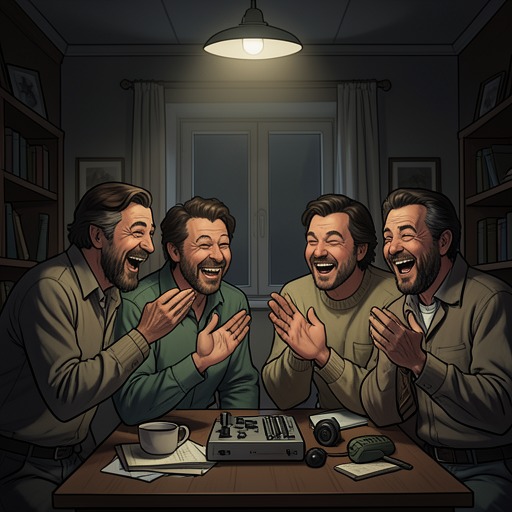
“You have to laugh at the things that hurt you”
One Flew Over the Cuckoo's NestThe expression You have to laugh at the things that hurt you gives shape to Randle McMurphy’s approach to pain: humor helps people keep their balance, but it does not make suffering disappear. During the boat trip, the idea moves beyond McMurphy’s own laughter, gathering the people around him into a moment of shared amusement that Chief Bromden experiences as both collective and strangely expansive.
Meaning and Balance
McMurphy’s laughter holds pain and humor together rather than allowing either to erase the other. Chief Bromden recognizes that the scene contains real hurt and discomfort, yet McMurphy refuses to let that pain blot out the humor. The principle is therefore not simple cheerfulness or denial. Laughter serves as a way of maintaining one’s footing in a world that can otherwise overwhelm a person.
The phrase’s emphasis on balance is central: humor answers pain without claiming to cure it. McMurphy’s example makes room for both at once, and that tension gives the laughter its force. It is a response to what hurts, not proof that nothing hurts.
Laughter Becomes Collective
At first, McMurphy’s laughter is his own, but it draws others into the same response. Dale Harding, Scanlon, the young woman, Sefelt, Dr. Spivey, and the rest of the group begin laughing too. Their amusement includes themselves as well as the people around them, loosening the separation between observer and observed.
The gathering matters because laughter passes among people rather than remaining McMurphy’s private performance. The group’s response makes the moment communal: those who have been caught up in discomfort can also see themselves and one another with humor. McMurphy’s influence appears here not as an argument but as an example that others take up.
Bromden’s Vision of the Moment
Chief Bromden describes himself as part of the laughter and, at the same time, somehow apart from it. His perspective shifts into an elevated view of himself, the group, and the boat among diving birds. This change in vantage turns an immediate gathering into an image he can see whole: McMurphy surrounded by his people, with laughter extending outward from them.
The laughter’s reach expands in Bromden’s telling, moving in widening circles across the water and toward beaches along the coast and beyond. That enlargement gives the moment a force beyond its immediate setting without changing its source: a group of people laughing together. The expression thus connects personal endurance with shared release, while Bromden’s vision makes their brief solidarity seem to travel far beyond the boat.